

Feeding facts essential to
know
My PhD supervisor co-hosted a webinar on feeding.
It was full of gold!
I’d love to share some of the great information that was discussed. Although focused on babies, even if you have moved well beyond the baby stage there are some interesting observations that may be super helpful.
This general awareness may help to prevent fussy eating too so I’d love for us to be more informed so we can better help friends and family (and those future grandchildren  ).
).
Feeding facts: What we taste and why
Expectations
One of the speakers used orange juice to explain a little more about taste buds. There are some good learnings in this, and I will also add my own spin!
When we look at a glass of orange juice, we assume it’s sweet. Why? Because prior experience tells us it will be. We have expectations about food/drinks when we approach them. These thoughts can have a significant impact on how we will find that food/drink.
Many parents are surprised (frustrated?) that their child will happily eat new cookies or sweets but be fearful of mealtime foods. The reason for comfort with new dessert-style foods is generally based on prior experiences and expectations.
If you approach a holiday, a sport, or a food thinking that it will be awful and you won’t enjoy it, it often becomes the truth. Having a positive mind-set is important in many aspects of our lives.

Taste buds
But what happens when you brush your teeth and then drink orange juice? It tastes absolutely awful. Why?
Usually when you are drinking orange juice the receptors in your taste buds pick up the sweetness and transmit that message to the brain. But toothpaste interrupts the sweet messages and so the body notices the natural bitterness in the orange juice that is normally masked by the sweetness.
The toothpaste also contains surfactants which again block the sweetness receptors.
You also need your nose to interpret smells. Collectively, the receptors in the nasal cavity and on your tongue combine to produce flavour.
This is part of the reason why pouches are such a hit with many children as they are receiving muted flavour messages to the brain because the nose is taken out of the equation.
Unfortunately, there are many receptors that pick-up bitterness in foods. This is in many ways an evolutionary protection measure as it is designed to prevent us from eating foods that may be poisonous.

However, it also means that many vegetables, especially the greens can taste quite bitter. For babies who are primed to enjoy the sweetness of breast milk this can be a bit of a shock. You may not think of milk as sweet, but it is how it is experienced by a baby (and the reason milk can cause cavities if you sleep without brushing teeth afterwards).
For babies therefore it’s best to introduce those greens very early so a child does get used to eating them.
For older children greens may be more of a challenge to introduce than other foods because of their look, taste, and texture, but knowing your child intimately can be a superpower.
Feeding facts about eating more greens
What makes foods easy or challenging for your child? Is it the visual, the texture or the taste? When I spent time working directly with children, my first task was to figure out which of these was most important.
1. If it’s visual – how can you make food look more appealing? Sometimes that is burying it in cheese or mixing it into a smoothie or a muffin.
2. If it’s texture – you can cook vegetables in different ways and that can be the difference between acceptance and discomfort. For example, most fussy eaters prefer raw to cooked veg.
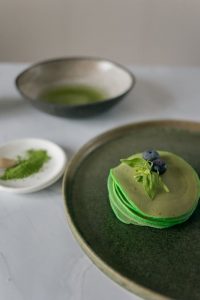
Green veg like kale can be roasted until crunchy or you can add spinach to other foods, like pancakes or pasta sauce where the texture is then not apparent.
3. If it’s taste – bitterness can be masked by sweetness or fats so you can use that to your advantage. Although you may not want to add sugar to the spinach you can use creamy sauces or marry it with cheese to mask some of the bitterness.
Or add sweetness, honey roasted carrots anyone?
Over time you do become more used to the flavour profiles of even the bitter foods, and they are easier to eat. To begin with you may just need some scaffolding to give them the ability.
Priming children to accept bitter greens
There are also ways you can program a baby to be more accepting of green foods/more bitter tastes.
There are 3 time-points where you can make a difference through your habits:
1. The maternal diet – I know, more responsibility to dump on mums 🙁 Particularly at a time when often you may not feel great, and spinach is not top of the craving list.
But the science says baby’s taste buds develop really early on. During the 7-8th week of gestation they are forming. While still in the womb babies have functioning adult-style taste buds.

Babies swallow more amniotic fluid when it’s sweet, so they are definitely tasting the food that mum eats. Therefore, including lots of greens does help to prime those tastes for your baby.
2. Breastfeeding – if breastfeeding is possible then again it is an opportunity to share the flavours of the foods you’d love your child to eat once they are ready.
3. The first month of feeding – there are critical periods of time for programming taste preferences. A recent study in Aotearoa NZ tested what would happen with babies who were fed just vegetables (and the bitter rather than the sweet ones) plus meat for iron, for the first month of feeding.
The parents in the study held off on the fruit and carbohydrates and instead fed baby a range of veg and meats.
The results showed that babies fed veg and meat for the first month were far more receptive to greens than those who were given carbs and fruit first.
I read about a similar study before feeding my first son and did try veg first before fruit, although I included the sweet ones like carrots as well as more bitter ones like spinach. I did find he found the greens as palatable as the fruit. I also mixed with expressed breastmilk so he was receiving both a familiar taste and the sweetness!

The theory is that starting with sweet, starchy foods may be reinforcing a love of those tastes and the science seems to show that 6 months is a sensitive window for taste training.
Most of us have totally missed that window, but I feel there are messages in this for parents of older children too.
Lessons from the babies
1. Priming taste buds – if you are used to receiving certain tastes it programs how you react to others, especially if bitter. It’s why it’s important to vary the tastes your child is used to, even if it’s only slightly.
It’s also why snack foods can quickly become a staple as they have a uniform taste. Similarly, formula always tastes exactly the same (as opposed to breastmilk which varies dependent on what mum eats) so a child used to drinking formula or milk is being programmed to accept specific tastes.
Commercial baby foods tend to have fruit as one of the ingredients – which primes a child to expect sweet foods and to prefer the ones that are.
2. Textures – smooth baby pouches/jars teach a child to accept foods that are ‘manufactured quality’ smooth. Food that has even a little more texture teaches baby to eat things with lumps and ‘bits’.

Even if your child is older, varying textures is an important part of supporting them to accept different textures.
Hopefully these feeding facts have provided some food for thought!
Any questions, please feel free to ask. I’m always happy to respond.
Judith, MA Cantab (Cambridge University), MSc Psychology (first-class honours), is working on a PhD, an AOTA accredited picky eating advisor and internationally certified nutritional therapist. She works with 100+ families every year resolving fussy eating and returning pleasure and joy to the meal table.
She is also mum to two boys and the author of Creating Confident Eaters and Winner Winner I Eat Dinner. Her dream is that every child can approach food from a place of safety and joy, not fear.
Learn more about Judith here: https://theconfidenteater.com/about/