
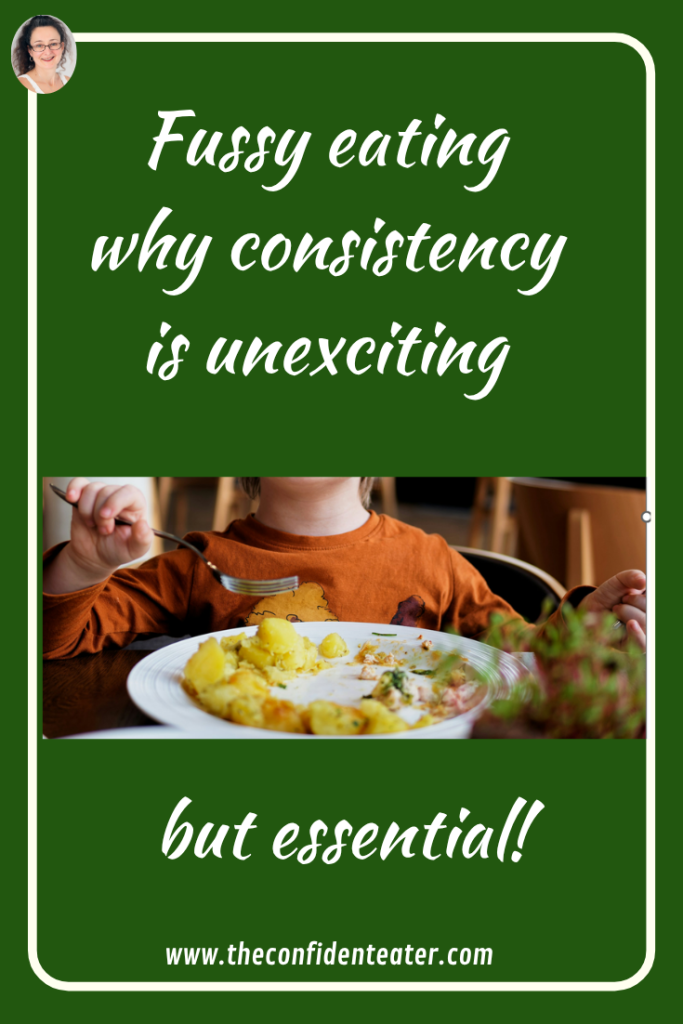
Fussy Eating – Why Consistency Is Unexciting but Essential
If I could offer one piece of advice to parents where feeding is a challenge, I would want to say ten things. But one of them would definitely be “many parents do not do things for long enough or consistently enough to see change”. The problem with this advice is that it does not feel radically new or give you a juicy new strategy. However, let me lay out how and why it’s important.
1. Familiarity takes time: Research shows that the average number of times a parent offers a food to their child before giving up is five. However, it can take far more exposure than that before a child is comfortable accepting a new food (there is no magic number).
Repeatedly offering your child new foods is essential and the more food anxious they are the more time it may take.
2. Your child is like an iceberg: That you see happening for your child is likely only a very small percentage of their learning. You serve them the carrot or the chicken over and over thinking “wasting my time”, but actually a lot of learning is often happening below the conscious level. See point 1, it’s really easy to give up because you feel that you are not making any progress as your child is not eating the carrot or the chicken.
However, if familiarity takes time AND you don’t see much of that happening it can feel disheartening. But like learning to read your child is learning things even when you can’t see it.
Importantly, progress may not look the way you are expecting. Spoiler alert progress may not be just be them eating a new food.
3. Comfort is key: Feeding is complex, it involves all the organs and all the senses. There are multiple places where it can feel less than comfortable for your child. Therefore, building comfort with a food is super important before they are able to eat it. There are two simple ways you can do this:
4. Consistent exposure: Having food readily available at the table where your child can watch you eating foods and they get the chance to see them on a regular basis builds comfort.
5. Interaction: The next ‘level up’ from exposure is interaction with those foods which is often best done away from the table. Your child could help with shopping, prepping or cooking foods and in this way is gently and organically getting more comfortable with foods by being in close contact and handling them.
6. Consistency: The key to all of these is consistency. Serving the carrots every day for two weeks and then giving up is unlikely to provide the learning and comfort necessary for progress, particularly if your child is neurodivergent, has sensory aversions and/or is very food anxious. Although consistency can feel hard there are some simple ways to not feel like you are wasting your time and also to build it into your routine.
7. Not wasting time: Think of learning to read. You read to your child for 4-5 years without them reading back to you. The books you read over and over are building blocks for literacy. Serving the carrot or the chicken over and over helps in the same way, it’s building feeding competency via comfort. So instead of thinking “this is pointless” think “building blocks” and, like the book/reading it may take consistent repetition done with love to get to the end game.
8. Build into routines: Offering foods does not have to be wasteful or time-consuming. Serving small quantities side-steps waste and can also be easier for your child to manage. A small wheel of carrot is not make or break budget-wise and may feel a lot more do-able for your child than a whole carrot. If you can offer parts of your meal or foods that you generally eat, then again it feels far easier. Bonus points as then your child is also seeing you eating the food, which helps builds comfort. Role modelling is an important part of learning.
On a final note, progress may not look the way you have been led to believe. As a society we expect to serve a food and have it eaten. When this does not happen, it is easy to think of it as a fail.
However, often steps forwards may not be a food in the mouth but are never-the-less just as important.
For example, building comfort for your child may be going from upset over eggs or bananas to then tolerating them firstly on the table near them and secondly on their plate. Those small steps may not feel important but are showing you that your consistency and hard work is paying off and your child is becoming more comfortable around those foods. Without that basic level of comfort progress is unlikely, but with it you are moving forwards.
Judith, MA Cantab (Cambridge University), MSc Psychology (first-class honours), is working on a PhD, is an AOTA accredited picky eating advisor and internationally certified nutritional therapist. She works with 100+ families every year resolving fussy eating and returning pleasure and joy to the meal table.
She is also mum to two boys and the author of Creating Confident Eaters and Winner Winner I Eat Dinner. Her dream is that every child can approach food from a place of safety and joy, not fear.
Learn more about Judith here: https://theconfidenteater.com/about/